When Architecture Lives on Whiteboards
Why Teams Struggle to See the Whole System
 by Guillermo Quiros
In many organizations, architecture is not documented in one place.
It exists in fragments — across whiteboards, notebooks, and people's memories.
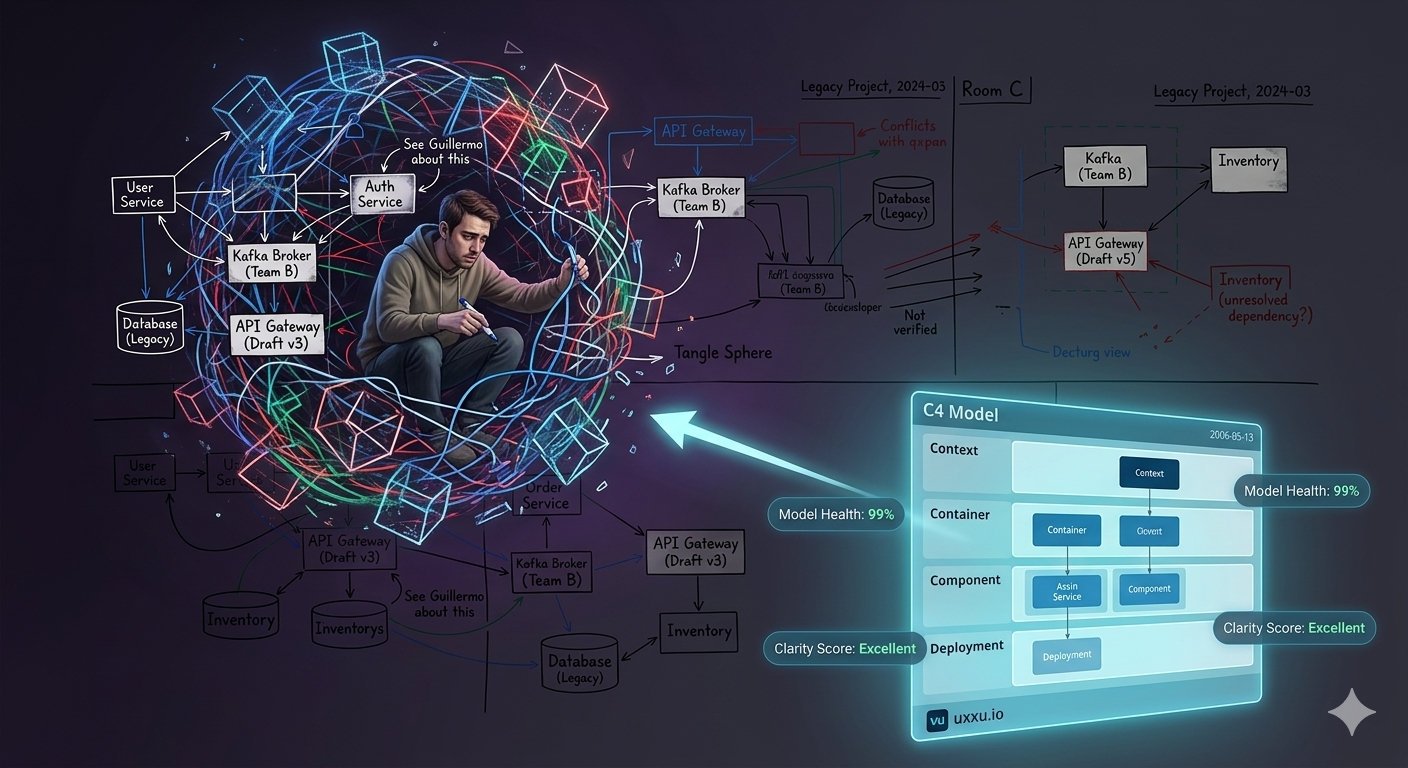
The Fragmented Architecture Problem
In many large organizations, architecture is scattered across meeting rooms.
One team’s whiteboard shows part of the system.
Another team has a slightly different version drawn in another room.
Someone else maintains their own sketch in a notebook.
None of these drawings fully match.
Each diagram represents a local understanding of the system, shaped by the perspective of the team that created it.
This fragmentation creates a surprising challenge.
No single place shows the complete architecture.
Instead, the architecture exists as a collection of partial views.
The Onboarding Maze
This fragmentation becomes particularly visible when someone new joins the team.
Instead of opening a clear architecture document, new engineers often experience something like this:
They are walked from meeting room to meeting room.
One engineer explains a whiteboard diagram.
Another engineer explains a slightly different version.
A third team introduces yet another view of the system.
Each explanation fills in a piece of the puzzle.
But none of them reveal the entire picture.
It can take months before a new developer feels confident about how the system really works.
This is not because the engineers are incapable.
It is because the architecture is not captured in a way that allows people to explore it progressively.
Why Whiteboards Persist
Whiteboards remain popular for a reason.
They are fast.
During design meetings, engineers can quickly draw:
- systems
- services
- databases
- APIs
- dependencies
Whiteboards allow ideas to flow freely.
They are perfect for brainstorming and discussion.
But they are not designed for long-term documentation.
Once the meeting ends, the diagram begins to decay.
Markers fade.
Boards are erased.
Photos become hard to read.
Eventually, the architecture must be redrawn again in the next meeting.
The Hidden Cost of Recreating Diagrams
Many teams underestimate how much time is spent recreating architecture diagrams.
Consider what happens during a typical architecture discussion:
- Someone redraws the current system.
- The team debates whether the diagram is accurate.
- People correct missing components.
- The discussion finally begins.
The first half of the meeting is often spent reconstructing the architecture before meaningful decisions can be made.
Over time, this repeated reconstruction becomes a hidden cost of whiteboard-driven architecture.
When Architecture Becomes Tribal Knowledge
When diagrams disappear after meetings, architecture knowledge moves somewhere else:
into people's heads.
Senior engineers become the primary source of architectural understanding.
They know:
- why the system was designed a certain way
- where the dependencies live
- which components are fragile
While this knowledge is valuable, relying on individuals creates risk.
If those engineers leave the company or change teams, the architectural context disappears with them.
This phenomenon is often called tribal knowledge.
It makes systems harder to maintain and even harder to evolve.
The Need for Structured Architecture Views
To solve these problems, architecture needs something whiteboards cannot provide:
structure.
A good architecture model should allow teams to:
- understand the system at different levels
- navigate from high-level concepts to technical details
- keep diagrams consistent over time
- collaborate across teams
This is where the C4 Model becomes extremely valuable.
A Layered Approach to Architecture
The C4 Model proposes a simple but powerful idea.
Instead of drawing one diagram that attempts to show everything, architecture should be described using multiple layers.
Each layer answers a different question.
These layers typically include:
- System Context – How the system fits within its environment
- Container – The major building blocks of the system
- Component – The internal structure of containers
- Deployment – How the system runs in infrastructure
By separating architecture into layers, diagrams become easier to understand.
Instead of overwhelming readers with details, each diagram focuses on a specific level of abstraction.
Why Layered Diagrams Work
Layered architecture diagrams solve several problems simultaneously.
They Reduce Cognitive Overload
A single diagram showing everything becomes unreadable.
Layered diagrams allow readers to zoom into the level they need.
Executives may look at the system context.
Developers may explore containers and components.
DevOps teams may focus on deployment.
They Encourage Consistency
Because diagrams are related hierarchically, each level builds on the previous one.
A component diagram explains the internal structure of a container.
A container diagram explains the system.
This creates a logical navigation path through architecture.
They Age Better Over Time
Whiteboard diagrams decay quickly.
Layered architecture models can evolve alongside the system.
When a new component is added, only the relevant diagrams need to change.
This makes architecture documentation far more maintainable.
Discovering Structured Architecture Modeling
I first encountered this approach while exploring architecture examples on:
The examples demonstrated how even complex enterprise systems could be documented clearly without relying on endless whiteboard sessions.
Instead of a single overloaded diagram, architecture was broken down into structured layers.
Each view remained readable.
And more importantly, each view stayed connected to the rest of the architecture.
From Temporary Sketches to Shared Architecture
Curious about how this approach would work in practice, I experimented with the modeling environment available at:
The difference became obvious almost immediately.
Instead of redrawing architecture repeatedly, teams could build on a shared architectural model.
Everyone could access the same diagrams.
Discussions no longer depended on who happened to be in the room when a diagram was originally drawn.
Architecture stopped being tied to physical spaces like meeting rooms.
It became something the entire organization could explore.
Collaboration Changes When Architecture Is Shared
Once architecture is modeled structurally, collaboration becomes easier.
Teams can discuss the system using a common visual language.
Developers working on different services can see how their work affects the broader system.
Product teams can understand system boundaries.
Infrastructure teams can reason about deployment and scalability.
Architecture stops being a static drawing and becomes an active part of engineering discussions.
Architecture as a Living Artifact
The most important shift is conceptual.
Architecture diagrams should not be treated as documentation that is created once and forgotten.
They should be living artifacts.
Living architecture evolves with the system.
When a service is added, the architecture model updates.
When dependencies change, the diagrams reflect those changes.
Over time, the architecture becomes a reliable representation of reality rather than a historical snapshot.
Conclusion
When architecture lives on whiteboards, it becomes fragmented.
Teams rely on partial drawings, personal notes, and memory to understand systems.
This fragmentation slows onboarding, complicates collaboration, and increases the risk of architectural drift.
The C4 Model offers a different path.
By organizing architecture into clear, progressive layers, teams can replace scattered sketches with structured, maintainable views of their systems.
Instead of walking people through rooms filled with diagrams, organizations can provide something far more valuable:
a shared architectural map that evolves with the system itself.