**Software architecture books** are the fastest way to build the mental models that separate engineers who write code from engineers who design systems. The best ones do not just describe patterns — they change the way you think about structure, communication, and trade-offs.
This list covers the ten books that have had the most durable impact on how software architects think and work. It is not a list of the ten most recently published books, and it is not a list of the ten most popular books on Amazon. It is a list of the books that, once read, change how you approach architecture permanently.
Each entry includes what the book is actually about, who should read it, and — critically — what you should do differently in your work after reading it.
Table of contents
- 1. Software Architecture: The Hard Parts
- 2. Fundamentals of Software Architecture
- 3. Designing Data-Intensive Applications
- 4. Clean Architecture
- 5. The Software Architect Elevator
- 6. Building Microservices
- 7. A Philosophy of Software Design
- 8. Software Architecture in Practice
- 9. Team Topologies
- 10. The C4 Model for Visualising Software Architecture
- How to use these books together
- Frequently asked questions
1. Software Architecture: The Hard Parts {#hard-parts}
Neal Ford, Mark Richards, Pramod Sadalage, Zhamak Dehghani (2021)

The book that finally addresses the questions architects actually face.
Most architecture books describe how to build systems correctly. This one describes how to make difficult decisions when there is no clearly correct answer. The title is not a marketing hook — it is an accurate description of the content.
What it covers
The book is organised around the decisions that are genuinely hard in modern distributed architectures: when to break apart a monolith, how to handle data decomposition across services, how to manage distributed transactions without two-phase commit, how to think about contracts between services, and how to reason about trade-offs when every option has significant downsides.
Each chapter presents a realistic architectural scenario — a fictional company called Sysops Squad — and walks through the analysis process for a specific hard decision. The authors do not prescribe solutions. They model the thinking process.
The data decomposition chapters are worth the price of the book alone. The distinction between ownership decomposition and data domain decomposition, and the five different patterns for handling shared data between services, represent some of the clearest thinking on microservices data architecture available in print.
Who should read it
Senior engineers moving into architecture roles. Architects working in organisations mid-transition from monolith to services. Anyone who has read the microservices literature and found it unhelpfully optimistic about the real costs.
What to do after reading it
Start documenting your architecture decisions using Architectural Decision Records. The book's analysis framework — identifying the trade-offs, stakeholders, and constraints before making a decision — maps directly onto ADR format. If your team does not yet use ADRs, this book will make you want to start.
2. Fundamentals of Software Architecture {#fundamentals}
Neal Ford and Mark Richards (2020)

The most comprehensive single-volume introduction to software architecture as a discipline.
If you read only one book from this list, make it this one. It covers more ground than any other architecture book — architectural styles, architecture characteristics (what used to be called non-functional requirements), architectural decisions, diagramming, soft skills, and the role of the architect within an organisation.
What it covers
The book opens with a definition of software architecture that is worth memorising: architecture consists of the structure of the system combined with the architecture characteristics it must support, the architecture decisions that have been made, and the design principles that guide development. This four-part definition gives the rest of the book its structure.
The chapters on architecture characteristics — availability, scalability, elasticity, reliability, testability, deployability, and so on — are particularly useful. The authors introduce the concept of architecture fitness functions: automated tests that verify whether a system still exhibits the characteristics it was designed to have. This idea, borrowed from evolutionary computing, has become one of the most practically useful additions to the architecture toolkit in the last decade.
The chapter on diagramming is honest about the current state of the field — most architecture diagrams are ambiguous and inconsistent — and introduces the C4 model as the clearest available framework for structured architecture communication. This is where many engineers first encounter the C4 model.
Who should read it
Engineers who want to understand what software architecture is and what software architects do. Junior and mid-level engineers building toward architecture roles. Engineering managers who want to understand the discipline well enough to work effectively with architects.
What to do after reading it
Audit your current system against the architecture characteristics defined in the book. Most systems have implicit assumptions about characteristics like scalability and reliability — this book gives you the vocabulary and framework to make those assumptions explicit. Then draw a C4 Context diagram for your system. The book explains why; doing it will show you how much clarity a single diagram provides.
3. Designing Data-Intensive Applications {#ddia}
Martin Kleppmann (2017)

The definitive guide to the data systems that underpin every modern architecture.
This is not an architecture book in the traditional sense — it does not describe architectural styles or discuss the architect's role in an organisation. It is a deep, rigorous treatment of databases, distributed systems, and data engineering that every architect must understand because data is the substrate that all architectural decisions are made on top of.
What it covers
The book is divided into three parts. Part one covers the foundations of data systems: reliable, scalable, and maintainable data storage — covering data models, storage engines, encoding formats, and replication. Part two covers distributed data: replication, partitioning, transactions, and the fundamental problems of distributed systems (consensus, linearisability, ordering guarantees). Part three covers derived data: batch processing, stream processing, and the architecture of data-intensive applications.
The chapters on transactions and distributed systems are among the best technical writing in computer science. The explanation of isolation levels — read committed, repeatable read, serialisable — and the failures each is designed to prevent is clearer than anything in the database literature. The chapter on the trouble with distributed systems should be required reading for anyone designing systems that span multiple nodes.
Who should read it
Any engineer working on systems that handle significant data at scale. Architects designing microservices architectures where data ownership and consistency are design constraints. Anyone who has used databases for years but wants to understand what is actually happening underneath.
What to do after reading it
Review the data stores in your architecture — your C4 Container diagram is the right place to start — and for each one, ask: what consistency model does it provide? What happens to this data store under network partition? What are the replication guarantees? Most architects cannot answer these questions about their own systems. This book gives you the framework to find out and the language to document what you find.
4. Clean Architecture {#clean-architecture}
Robert C. Martin (2017)
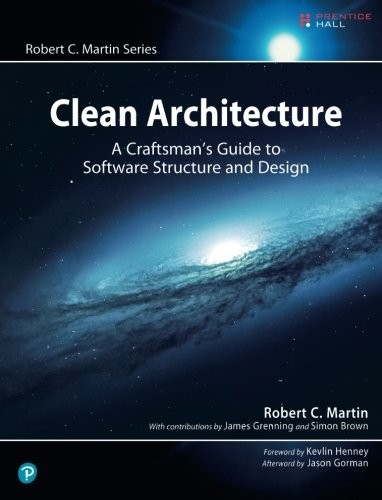
The most influential argument for keeping business logic independent of infrastructure.
Robert Martin's contribution to software architecture is the Dependency Rule: source code dependencies must always point inward, toward higher-level policies, never outward toward lower-level details. The entire book is an elaboration of this principle and its implications.
What it covers
The book covers SOLID principles, component principles (cohesion and coupling), and the architecture patterns that follow from applying the Dependency Rule rigorously: the Hexagonal Architecture (also known as Ports and Adapters), the Clean Architecture itself, and screaming architecture — the idea that a system's architecture should shout its purpose, not its framework.
The chapters on component coupling are particularly useful. The Stable Dependencies Principle and the Stable Abstractions Principle give architects a formal way to reason about which components should change frequently and which should be stable — and how to structure dependencies so that unstable components depend on stable ones, never the other way around.
The final chapters on the database as a detail and the web as a detail are provocative and important. Martin argues that persistence and delivery mechanisms are implementation details that should be entirely separable from the application's core business logic. Systems built this way are dramatically easier to test and to evolve.
Who should read it
Engineers frustrated by systems where changing a database requires modifying business logic, or where the framework choice pervades every layer of the application. Architects designing systems that need to be maintainable over long time horizons. Anyone who has ever rewritten an application just to change the delivery mechanism.
What to do after reading it
Look at your C4 Component diagram and ask: which components depend on infrastructure? Can you draw a line between the components that encode business logic and the components that interact with databases, message queues, and external APIs? If the business logic components have outward dependencies on infrastructure, Clean Architecture gives you the vocabulary and the patterns to restructure them.
5. The Software Architect Elevator {#elevator}
Gregor Hohpe (2020)

The book that explains what a software architect actually does — and why most organisations do it wrong.
The metaphor in the title is the book's central argument: an effective software architect rides the elevator between the penthouse (where business strategy is set) and the engine room (where code is written), translating between the two and ensuring that technical decisions serve business goals and vice versa. Most architects ride only one floor.
What it covers
The book is a collection of essays on the practice of software architecture and the role of the architect in large organisations. It covers technical topics — abstraction, patterns, the value of architecture — but its most distinctive chapters are on organisational dynamics: how architects communicate across levels of hierarchy, how to drive change in resistant organisations, how to think about IT transformation, and how to avoid the traps that make architects ineffective.
The chapter on the difference between modelling and documenting is particularly sharp. Most architecture diagrams, Hohpe argues, are documentation of systems that already exist — they describe what is, not what should be. Good architecture modelling is prospective — it explores design spaces and informs decisions before they are made. This distinction changes how you think about every diagram you draw.
Who should read it
Mid-career engineers becoming architects. Architects who feel disconnected from business decisions. Engineering leaders trying to understand why their architecture function is not delivering value. Anyone who has found themselves unable to influence the decisions that matter.
What to do after reading it
Identify the elevator in your organisation — the path between business strategy and technical implementation. Where are the translation gaps? Who speaks both languages? This book will make you think about architecture as an organisational function, not just a technical discipline.
6. Building Microservices {#microservices}
Sam Newman (2nd edition, 2021)

The most complete and balanced treatment of microservices architecture available.
The first edition of Building Microservices, published in 2015, did more than any other single work to popularise microservices as an architectural style. The second edition, substantially revised in 2021, incorporates the hard lessons learned in the years since — including Newman's own more nuanced view of when microservices are and are not the right choice.
What it covers
The book covers microservices from first principles: what they are, why you would use them, how to model service boundaries using Domain-Driven Design concepts, how to handle communication between services (synchronous vs asynchronous, REST vs gRPC vs messaging), how to manage data and consistency across service boundaries, how to test microservices, and how to deploy them.
The chapters on service decomposition are among the most practically useful in the architecture literature. Newman's treatment of bounded contexts — when and how to draw service boundaries — is clearer and more nuanced than most DDD texts.
The second edition is notably more honest about the costs of microservices than the first. Newman explicitly addresses the cases where a monolith is the right architecture — something the first edition largely glossed over. The modular monolith gets serious treatment as a legitimate architectural choice, not just a stepping stone to microservices.
Who should read it
Engineers building or planning to build distributed systems. Architects evaluating whether microservices are the right choice for their system. Teams mid-migration from monolith to services who want a comprehensive reference.
What to do after reading it
Draw a C4 Container diagram for your current system and mark each container with its team ownership. Newman's book gives you the framework to evaluate whether your current service boundaries are aligned with your team structure and your domain. Where they are not, you have identified architectural debt.
7. A Philosophy of Software Design {#philosophy}
John Ousterhout (2nd edition, 2021)

The most thoughtful book on the nature of complexity in software systems.
This is a short book — around 200 pages — but it contains more useful thinking about software design than many books three times its length. Ousterhout's central argument is that the most important skill in software engineering is the management of complexity, and that most software design decisions should be evaluated by whether they increase or decrease complexity.
What it covers
The book defines complexity precisely: complexity is anything in the structure of a system that makes it harder to understand and modify. Complexity has three symptoms — change amplification (a single change requires modifications in many places), cognitive load (a developer must know a large amount to make a change), and unknown unknowns (it is not obvious which code must be modified to make a change). Good design reduces all three.
The book introduces the concept of deep versus shallow modules. A deep module has a simple interface that hides a complex implementation — it provides a lot of functionality per unit of interface complexity. A shallow module has a complex interface relative to the functionality it provides. Good architecture is built from deep modules.
The chapters on information hiding, general-purpose modules, and tactical versus strategic programming are essential reading for any engineer who designs systems meant to last.
Who should read it
Engineers at any level who write code that others will read and modify. Architects who want to reason more clearly about why some systems are easy to change and others are not. Engineering leads evaluating code in design reviews.
What to do after reading it
Review the last three significant components you designed and evaluate them against Ousterhout's complexity criteria. Does each component hide information effectively? Is the interface simpler than the implementation? Where complexity has leaked through an interface, this book gives you the vocabulary to explain why and the design principles to fix it.
8. Software Architecture in Practice {#in-practice}
Len Bass, Paul Clements, Rick Kazman (4th edition, 2021)

The academic foundation of software architecture as an engineering discipline.
If Fundamentals of Software Architecture is the practical guide to the discipline, Software Architecture in Practice is its theoretical foundation. Originally published in 1997 and now in its fourth edition, it is the text from which most formal software architecture education is drawn.
What it covers
The book covers architecture in a more structured and systematic way than most other texts: quality attributes (their formal definitions, the tactics available to achieve them, and the patterns that implement those tactics), architectural views and viewpoints, architecture documentation, architecture evaluation (the ATAM method), and the relationship between architecture and the organisation that builds it.
The quality attribute chapters are particularly thorough. Each quality attribute — availability, interoperability, modifiability, performance, security, testability, and usability — is given a formal treatment: what it means, how to measure it, what architectural tactics are available to achieve it, and how those tactics interact with each other.
The ATAM (Architecture Tradeoff Analysis Method) chapters give architects a structured method for evaluating architectural decisions against quality attribute requirements — useful for architecture reviews and for communicating trade-offs to stakeholders.
Who should read it
Engineers pursuing formal architecture education. Architects who want a systematic framework for architecture documentation and evaluation. Teams that need to communicate architecture trade-offs to non-technical stakeholders in a structured way.
What to do after reading it
Apply the quality attribute scenario format from the book to your current system. Write three to five quality attribute scenarios — specific, measurable descriptions of how the system should behave under specific conditions — and evaluate your current architecture against them. This exercise almost always reveals gaps between what the architecture was designed to do and what it is being asked to do.
9. Team Topologies {#team-topologies}
Matthew Skelton and Manuel Pais (2019)

The book that explains why your architecture and your team structure are the same problem.
Conway's Law — any organisation that designs a system will produce a design whose structure mirrors the organisation's communication structure — has been known since 1967. Team Topologies is the first book to take this observation seriously as a design principle and to provide a practical framework for structuring teams to produce architectures that are maintainable, evolvable, and aligned with business needs.
What it covers
The book defines four fundamental team topologies: stream-aligned teams (aligned to a flow of work from a business domain), enabling teams (that help stream-aligned teams overcome obstacles), complicated subsystem teams (for components that require deep specialist knowledge), and platform teams (that provide internal services to stream-aligned teams). It also defines three interaction modes: collaboration, X-as-a-service, and facilitating.
The key insight is that cognitive load — the amount of complexity a team must manage — is a first-class architectural constraint. If a stream-aligned team owns too many services or components, cognitive load exceeds a manageable threshold and quality degrades. Good architecture distributes cognitive load appropriately across teams.
The concept of team cognitive load has become one of the most useful lenses for evaluating microservices architectures specifically. Newman's book tells you how to draw service boundaries technically; Team Topologies tells you how to draw them organisationally.
Who should read it
Engineering leaders and architects designing or restructuring engineering organisations. Anyone evaluating microservices architectures where team ownership is unclear. Product and engineering managers who want to understand why some team structures produce good software and others do not.
What to do after reading it
Map your current team structure against your C4 Container diagram. Which team owns which containers? Are any containers owned by multiple teams without clear interfaces between them? Are any teams responsible for so many containers that cognitive load is a plausible explanation for quality problems? Team Topologies gives you the framework to answer these questions and the patterns to restructure accordingly.
10. The C4 Model for Visualising Software Architecture {#c4-book}
Simon Brown (online, continuously updated)

The reference documentation for the most useful architecture diagramming framework available.
This is not a traditional book — it is the living documentation at c4model.com, maintained by Simon Brown, the creator of the C4 model. It is included here because it is the definitive reference for the framework that has done more than any other single contribution to improve the quality of architecture diagrams produced by software teams.
What it covers
The C4 model defines four levels of architecture diagram — Context, Container, Component, and Deployment — each targeting a different audience and answering a different question. The documentation explains what each level shows and excludes, provides notation guidelines, addresses common mistakes, discusses tooling, and answers the frequently asked questions that arise when teams adopt the model.
The model's core insight — that different audiences need different levels of abstraction, and that a single diagram cannot serve all of them — is simple but has profound implications for how architecture documentation is produced and maintained.
The supplementary material on diagram review, common mistakes, and the relationship between the C4 model and UML is as valuable as the core model definition. The section on the most common C4 model mistakes — including the tendency to show internal components as external systems, and the habit of omitting relationship labels — reads like a catalogue of every architecture diagram failure mode you have ever seen.
Who should read it
Every software engineer who draws or reads architecture diagrams — which is to say, every software engineer. Teams adopting the C4 model for the first time. Architects who want a framework for consistent, audience-appropriate architecture documentation.
What to do after reading it
Draw a C4 Context diagram for the system you know best. Then draw the Container diagram. Show both to a non-technical stakeholder and a junior engineer and ask each of them what questions the diagram answers and what questions it leaves open. The gap between what you think the diagram communicates and what they actually take from it is the gap the C4 model is designed to close.
For teams that want to move beyond static C4 diagrams to live, interactive architecture models, uxxu.io implements the C4 model natively — maintaining consistency across all four diagram levels and allowing diagrams to be embedded as live views in Notion, Confluence, Medium, and any website.
How to use these books together {#how-to-use}
These ten books are not independent — they form a curriculum. Read in sequence, they build a complete picture of software architecture from first principles to organisational practice.
Start with Fundamentals of Software Architecture if you are new to the discipline. It provides the vocabulary and conceptual framework that makes the other books easier to read.
Add Designing Data-Intensive Applications and Building Microservices once you have the foundations. Together they cover the two most consequential technical constraints in modern distributed architecture: data consistency and service decomposition.
Read Clean Architecture and A Philosophy of Software Design together. Both are about managing complexity at the component level — Clean Architecture from the perspective of dependency management, A Philosophy of Software Design from the perspective of information hiding and interface design. They complement each other closely.
Add Software Architecture: The Hard Parts when you are facing real architectural decisions with significant trade-offs. It is most useful once you have enough context to recognise the situations it describes.
Read The Software Architect Elevator and Team Topologies when you are moving from technical architecture work into organisational influence. Both address the gap between technical decisions and organisational reality.
Keep Software Architecture in Practice as a reference. It is the most systematic treatment of quality attributes and architecture evaluation — return to it when you need a formal framework for a specific quality attribute or an architecture review.
Use the C4 model documentation continuously — it is the practical tooling for every diagram you draw throughout your career.
Frequently asked questions {#faq}
What is the best book on software architecture for beginners?
Fundamentals of Software Architecture by Neal Ford and Mark Richards is the best starting point. It covers the full scope of the discipline — architectural styles, architecture characteristics, architectural decisions, diagramming, and the architect's role — in a single accessible volume. It assumes familiarity with software development but no prior architecture knowledge.
What is the best book on software architecture for experienced engineers?
Software Architecture: The Hard Parts by Neal Ford, Mark Richards, Pramod Sadalage, and Zhamak Dehghani is the most useful book for engineers who already understand the basics and are facing real architectural decisions. It addresses the problems that actually arise in practice — data decomposition, distributed transactions, service granularity — rather than the idealised scenarios most architecture books describe.
What books should a software architect read?
A software architect should read, at minimum: Fundamentals of Software Architecture for the disciplinary foundation; Designing Data-Intensive Applications for data systems literacy; Building Microservices for distributed systems; Clean Architecture for component design principles; Team Topologies for the relationship between architecture and organisation; and the C4 model documentation for architecture communication. The remaining books on this list — The Software Architect Elevator, A Philosophy of Software Design, Software Architecture in Practice, and Software Architecture: The Hard Parts — fill in the picture across different dimensions.
Is the C4 model documented in a book?
The C4 model is documented in Simon Brown's living documentation at c4model.com rather than a traditional print book. Brown has also written Visualising Software Architecture, a self-published book available on Leanpub, which covers the C4 model in more depth than the online documentation. Several other architecture books — including Fundamentals of Software Architecture — reference and explain the C4 model.
What is the difference between software architecture and system design?
Software architecture is the discipline of making structural decisions about a software system — defining its components, their relationships, and the principles that guide its evolution. System design, as the term is commonly used in technical interviews, refers to the process of designing a specific system to meet specified requirements, usually with a focus on scalability and reliability. System design is a practical application of software architecture principles. The books on this list cover software architecture at the conceptual level; system design interview preparation resources (like Designing Data-Intensive Applications) apply those concepts to specific scenarios.
How do C4 diagrams relate to what these books teach?
The C4 model gives concrete form to the architectural thinking described in these books. When Fundamentals of Software Architecture talks about architecture structure, the C4 Context and Container diagrams are how you document that structure. When Building Microservices talks about service boundaries, the C4 Container diagram is where you draw them. When Team Topologies talks about team cognitive load, the C4 Container diagram annotated with team ownership is how you visualise it. When Software Architecture: The Hard Parts analyses data decomposition, the C4 Component diagram is where you show the result. The C4 model is the notation; the other books on this list are the reasoning behind what you put in the diagrams.